AEROSLEDS
war doesn't stop when the snow falls
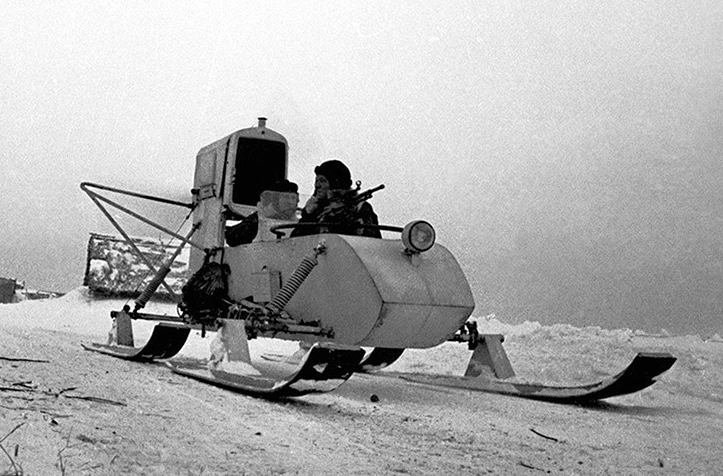
RF-8-GAZ-98 type motorised sled, source: Flickr.com, Public domain, edited
A Brief History
Among the most unusual pieces of combat equipment used by the Red Army in World War II were undoubtedly the propeller-driven motorised sleds. The first aerosleds, as these vehicles were called (Russian: aerosani), appeared in Tsarist Russia, where they served as a leisure and recreational transport for the wealthy.
As technological progress made internal combustion engines smaller and cheaper, production of motorised sleds grew and their use spread. All conditions favoured this: Russia's vast territory was served by a hopelessly inadequate road network, and the climate — particularly in the northern regions — was ideal for snow-going vehicles. The Communist regime that came to power in 1917 actively encouraged this trend, since the new Soviet Union suffered from a chronic shortage of modern means of transport, among much else.
From 1921 onwards several aerosled designs were produced. A highly successful designer in this field was A. N. Tupolev, who between 1921 and 1923 presented his ANT-I, ANT-II and ANT-III designs. The last of these was the first vehicle of its type to feature an all-metal hull — all earlier examples had been wooden. Aerosleds came into widespread use particularly in the northern parts of Russia, for passenger and cargo transport, mail delivery and scientific expeditions into the Arctic. The later ANT-IV type also served as an ambulance.
Military Use
It was not long before the military took an interest in motorised sleds. The army began using them for transport duties — carrying ammunition, supplies and other material into remote areas without roads, and evacuating the wounded from combat zones. ANT-IV aerosleds were deployed during the war with Finland, though always in a support role rather than a combat one, as they were not equipped for fighting. After war with Germany broke out in 1941, however, Soviet designers began working on new types capable of fulfilling combat roles as well. Several designs emerged from this effort, of which the best known became the NKL-26 and the RF-8-GAZ-98.
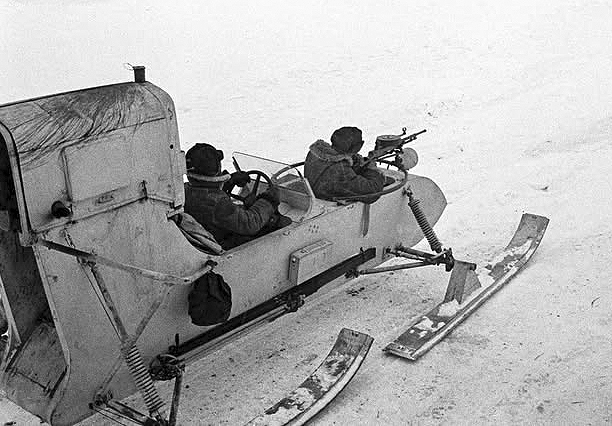
RF-8-GAZ-98 type motorised sled, source: Aviarmor.net with permission of the operator, edited
Type NKL-26
The NKL-26 was a fully enclosed sled with four independently suspended steerable runners. The hull was wooden, with only the front wall being armoured. The crew of two consisted of the driver, seated at the front, who controlled the vehicle by means of a steering wheel. His forward view was through a closeable rectangular port in the front wall — in dangerous areas this was shut and observation made through a slit in the cover. The second crew member was the commander, who also served as machine gunner.
Above the commander's position was a circular aperture in the roof, on the rim of which a 7.62 mm DT machine gun was mounted on a rotating ring, allowing it to traverse through 300°. The remaining 60° was the space occupied by the engine and propeller, into which the gun could naturally not be aimed. When firing, the commander had to stand up, exposing his head and shoulders above the roofline; a shield around the machine gun provided some protection in this position.
Entry and exit was through a door in the left side wall, and of course also through the gunner's roof aperture. Two small windows in each side wall provided lateral visibility. The vehicle ran on four wooden runners, all connected to the steering wheel through a system of rods and cables — with all four runners steerable, the vehicle was reasonably manoeuvrable. At the rear, the engine rose above the roofline: an air-cooled five-cylinder aircraft engine, the M-11, fitted with an electric starter and a fuel pre-heater for extreme cold. Attached to the engine was a simple two-blade propeller 240 cm in diameter. Metal guard tubes ran along the sides of the hull ahead of the propeller to deflect vegetation and prevent damage to the blades. The fuel tank was located at the rear of the hull, behind the commander's position.
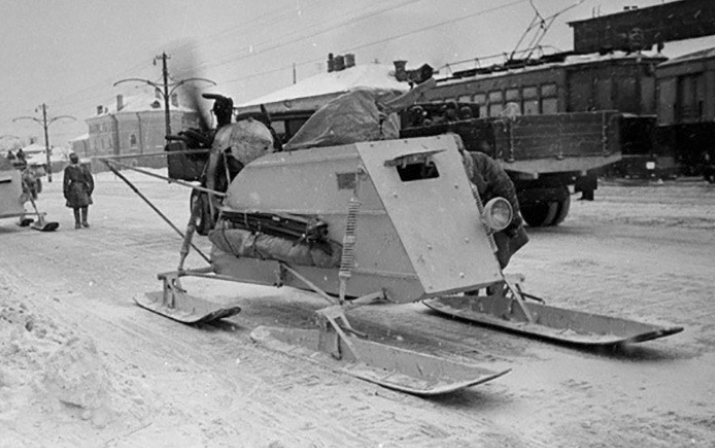
NKL-26 type motorised sled, source: Aviarmor.net with permission of the operator, edited
Type RF-8-GAZ-98
The second widely used type of military aerosled was the RF-8. The design was the work of M. V. Veselovsky, who in 1941 passed the plans for the RF-8 to the GAZ factory for production. The factory's own engineers made minor modifications to suit their manufacturing capabilities, and the first production run was completed before December 1941. The vehicle received the factory designation GAZ-98, which is why it is commonly referred to by three different names — RF-8, GAZ-98, or the combined form RF-8-GAZ-98.
Unlike all previous aerosled types, the RF-8 used not an aircraft engine but a standard production automotive engine — the GAZ-M-1. This significantly reduced the cost of the vehicle. Another important innovation was the use of a metal propeller in place of the wooden ones previously standard. This allowed the RF-8 to pass through much denser vegetation than its predecessors without risking propeller damage.
The RF-8 rode on four runners, of which the front two were steerable. The sled had a long, narrow wooden hull that was open at the top. The two crew members sat one behind the other: the gunner at the front, the driver behind him. Both men's upper bodies were exposed above the open hull. A metal rotating ring was fixed around the gunner's position, on which the machine gun was mounted. Its traverse was not a full 360° — it was restricted to prevent the weapon from being aimed rearward towards the driver, engine and propeller. The driver controlled the vehicle with a steering wheel and throttle and brake pedals. He also had one additional pedal with a special function: when the sled had been stationary for any length of time, the runners often froze to the snow. This pedal was connected to the springs of the right-hand runners; pressing it several times compressed the springs, tilting the vehicle slightly to the right, and when released the springs kicked back, causing the sled to bounce and break free from the surface.
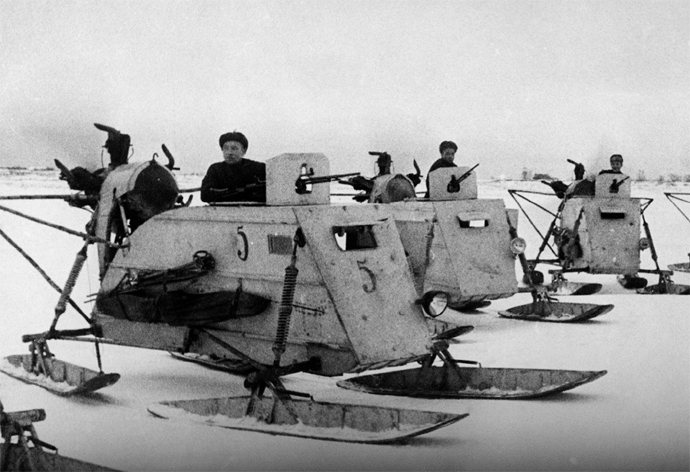
NKL-26 type motorised sled, source: Waralbum.ru with permission of the operator, edited
Behind the driver's position the hull housed an 80-litre fuel tank and a starter battery, above which sat the powerplant: a water-cooled automotive engine, the M-11, with a maximum output of 50 hp at 2,800 rpm. The engine radiator cowl extended above the driver's head. A two-blade propeller 235 cm in diameter was attached to the rear of the engine. Between 1942 and 1943 an improved variant designated GAZ-98K was produced, fitted with a more powerful 110 hp engine.
Combat Deployment
Aerosleds were used primarily for reconnaissance. Their speed and independence from roads allowed them to slip behind enemy lines and return with valuable intelligence. Beyond this, they could also intervene actively in combat and proved particularly effective when pursuing retreating enemy infantry. Experience showed that the best results were achieved on flat open plains, or better still on frozen rivers and lakes — the propeller drive was not well suited to broken terrain. Deployment was ruled out anywhere with trenches, trees or dense tall vegetation. A minimum snow cover of 10 to 12 cm was also required.
Aerosled units were advised to attack only from the flanks or rear, never head-on — primarily because of their low resistance to heavier weapons, let alone artillery. A very effective tactic was combining sleds with ski infantry: the sleds could tow the skiers behind them so that the infantry's slower pace did not hold back the attack. Depending on their load and the terrain, aerosleds could reach speeds of 25 to 35 km/h. Their main drawbacks were minimal protection against enemy fire and a relatively short operational range due to limited fuel capacity.

ARTICLE
CONTENTS:
Reproducing text from the Tankist website without the written consent of the operator is prohibited.