D-8
Armoured car on a Ford chassis
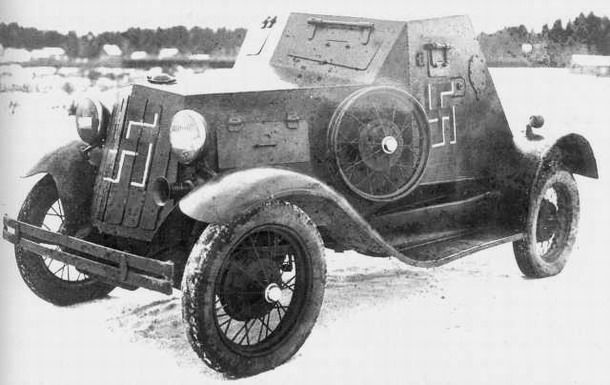
Armoured car D-8 in Finnish Army service, source: Aviarmor.net with permission of the operator, edited
Origins of the Vehicle
In 1930, licensed production of the Ford A passenger car began in Nizhny Novgorod. Shortly after production got underway, the Soviets decided to put these vehicles to military use as well. The Izhora plant was therefore tasked with developing an armoured car based on the Ford A chassis, under the direction of N. I. Dyrenkov. By the end of 1930, the first three or four test prototypes of the new vehicle, designated the D-8, were already complete.
Design and Construction
The vehicle was built on the aforementioned two-axle chassis. Along with the chassis, a number of components were carried over from the civilian car: the simple wire-spoked wheels, the front bumper, and the mudguards that ran along the full length of the vehicle. All of these elements gave the machine the appearance of a converted passenger car rather than a genuine military vehicle.
On top of the chassis sat a very compact armoured body, welded from seven-millimetre steel plates. The armour protected both the crew compartment and the engine, which was mounted at the front. The crew consisted of two men: a driver and a commander, who also served as the machine gunner. Entry and exit were provided by rectangular doors in both side walls of the cabin, and optionally through a hatch in the roof. Forward visibility was ensured by two vision ports that could be closed with armoured covers, after which observation was only possible through narrow slits in the covers. Similarly designed vision ports were also fitted in both side doors.
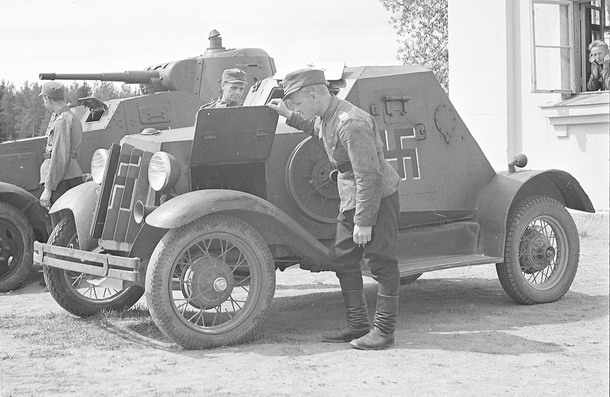
Armoured car D-8 in Finnish Army service, source: Wikimedia, Public domain, edited
The vehicle's sole integral armament was a 7.62 mm DT machine gun. However, its placement was somewhat unfortunate — it was mounted in an embrasure in the rear wall, meaning it could only fire to the rear. The onboard ammunition supply amounted to 2,090 rounds. The powerplant was also carried over from the licensed civilian car. The Ford A four-cylinder engine, with a maximum output of 40 horsepower, was capable of propelling the 1.6-tonne vehicle to a top speed of around 80 to 85 km/h — on a road and under favourable conditions, of course. The average cruising speed of the D-8 was only 30 km/h. The engine drove the rear axle only. The 40-litre fuel tank gave a range of up to approximately 200 km.
Production of the D-8 took place in 1931, with probably only 25 units built. That same year a second variant was developed, designated the D-12. The impetus for it was an army requirement for heavier armament. The D-12 therefore received a heavy water-cooled Maxim machine gun mounted on the roof of the cabin, while the original DT machine gun in the rear wall was retained. Sources are unclear as to whether the second weapon was accompanied by a second gunner, or whether the crew remained at two men. The D-12 was also produced in very limited numbers and was soon pushed out of Red Army service by more modern vehicles.
According to some sources, the D-8 saw combat during the Winter War with Finland. Several of these vehicles fell into Finnish hands and were subsequently pressed into Finnish service.
Technical Specifications
|
D-8 |
D-12 |
Weight |
1.6 t |
2.28 t |
Length |
3.54 m |
3.54 m |
Width |
1.70 m |
1.70 m |
Height |
1.68 m |
2.52 m |
Engine |
Ford A |
Ford A |
Max. power |
40 hp |
40 hp |
Top speed |
80 km/h |
80 km/h |
Fuel capacity |
40 l |
40 l |
Road range |
200 km |
200 km |
Armour |
7 mm |
7 mm |
Armament |
1 x DT machine gun 7.62 mm |
1 x Maxim machine gun 7.62 mm 1 x DT machine gun 7.62 mm |
Crew |
2 men |
2 – 3 men |

ARTICLE
CONTENTS:
Reproducing text from the Tankist website without the written consent of the operator is prohibited.